What a Scent Museum Visit Teaches a Product Team About Lead Times
A fragrance museum is usually presented as a visitor experience. For a product team it is more useful as a planning tool, because an exhibition compresses into an hour the fact that a smell is built in layers, that each layer needed its own trials, and that what a visitor registers in seconds took months to settle. That perspective is worth more than inspiration when a launch date is already fixed.
Key takeaways
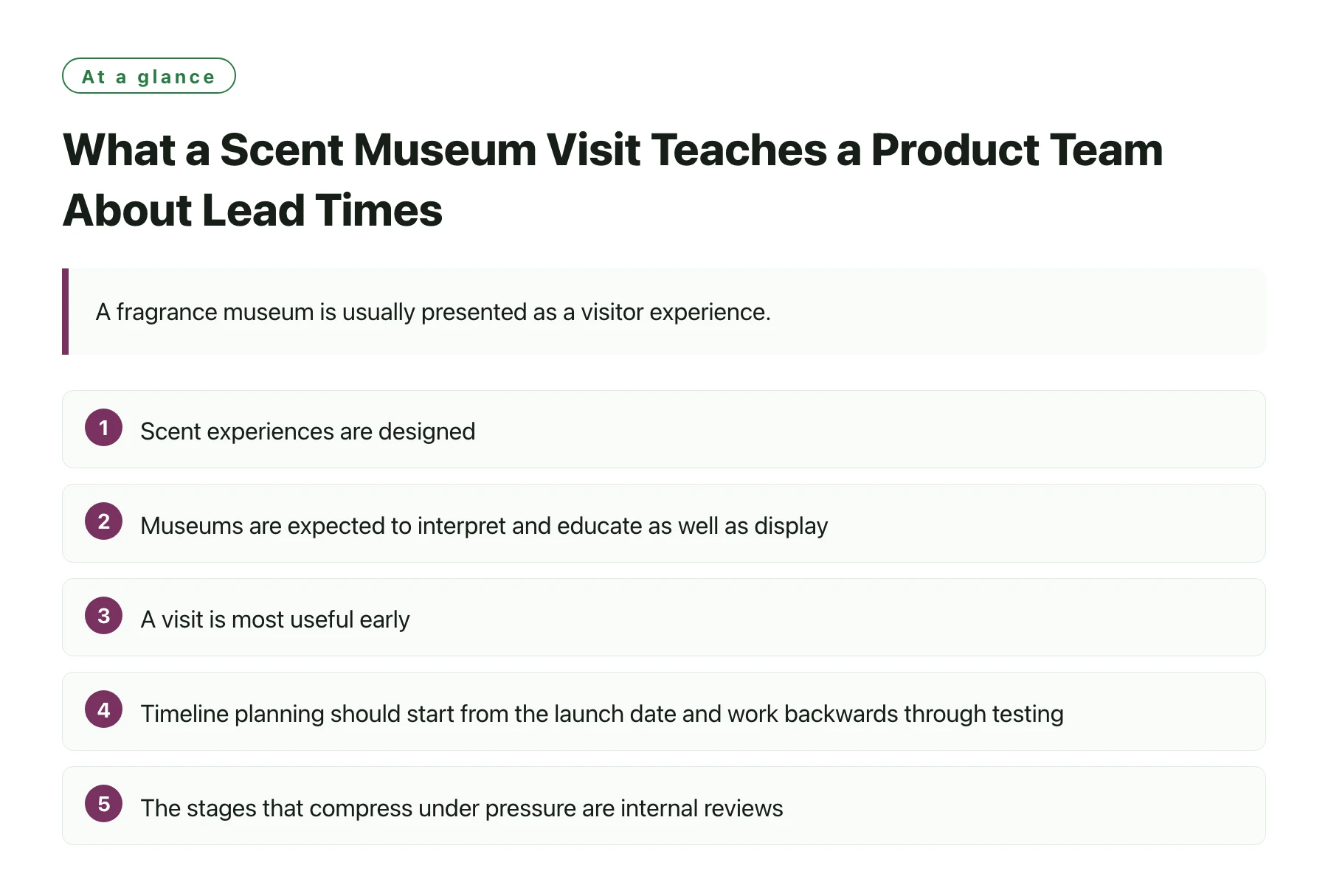
- Scent experiences are designed, not discovered; the structure behind an exhibition mirrors the structure behind a product brief.
- Museums are expected to interpret and educate as well as display, which is why scent exhibitions explain how a material or a technique works rather than only showing it [1].
- A visit is most useful early, before the brief is written, when the team still has room to change the direction.
- Timeline planning should start from the launch date and work backwards through testing, packaging and approval, not forwards from the brief.
- The stages that compress under pressure are internal reviews; the stages that do not are stability testing, print cycles and component lead times.
Brand teams often treat a museum trip as a reward at the end of a project, or as content for a mood board. Both uses waste the visit. Used properly, a scent exhibition is a fast, physical demonstration of how much iteration sits behind a finished smell.
This article is written for a product manager or brand lead who has to hand a launch date to a supply chain team and wants the plan to survive contact with reality.
Why a scent experience changes how a team briefs
Most product briefs are written in language. A scent exhibition replaces that language with structure: it shows that a fragrance has an opening, a middle and a base, that materials behave differently over time, and that a small change in one material alters the whole impression.
Teams that have walked through an exhibition together tend to brief differently afterwards. They stop asking for a smell and start specifying behaviour - how it should open, how long it should stay close to the skin, what it should not do. That shift reduces sample rounds, because the perfumer is no longer guessing which attribute matters.
Interpretation is the point
Museums are not warehouses of objects. The international museum community defines a museum partly by its role in interpreting and educating, which is why curated scent exhibitions explain how a material is extracted or how a technique developed rather than simply presenting a bottle [1]. For a brand team, that explanatory layer is the valuable part: it is a short course in how the product is made.
Visitor research and professional practice in the museum sector also emphasise how presentation shapes comprehension [2]. The parallel with retail is direct: how a fragrance is presented changes what a shopper perceives, which is a decision the brand controls and the factory does not.
Heritage is a product input, not only a story
Traditional perfumery practices are part of what the heritage framework recognises as living cultural knowledge, alongside other craft traditions [3]. For brands working with recognisable regional materials, that framing is practical rather than decorative: it points to ingredients and techniques that have documented histories, which can support a legitimate product story without inventing one.
Planning a launch backwards from the date
- Fix the retail date, then subtractWork backwards from the date the product must be on shelf, not from the date the brief is ready. The difference between those two anchors is usually the entire schedule risk.
- Reserve the testing window firstStability and compatibility testing are calendar-bound, not effort-bound. Place them before anything flexible and treat their duration as immovable.
- Place print and packaging nextPrint cycles, tooling and decoration approval are external queues. They need to sit on the calendar as fixed blocks rather than as tasks to be squeezed.
- Then schedule sample roundsThree to four rounds with a defined feedback turnaround each. If the available space does not fit them, the direction is too ambitious for the date.
- Assign a decision owner per gateEvery block on the calendar should have one person who can approve it. Shared approval is the most common cause of a quiet two-week slip.
- Keep a visible second laneShow brand decisions alongside technical work so that a delayed approval is visible before it delays production.
Where the time goes, and what actually shortens it
| Block | What sets its duration | What can shorten it |
|---|---|---|
| Brief and direction | Clarity of the brief and speed of choosing one direction | A common reference vocabulary built during the museum visit or a training session |
| Sample rounds | Turnaround between feedback and the next trial | Structured feedback that names attributes instead of giving a verdict |
| Testing | The duration required for the market and the pack | Choosing the pack early so compatibility testing runs in parallel |
| Print and decoration | External queues and the number of decoration passes | Fewer decoration steps, and artwork frozen earlier |
| Component lead time | Availability of the bottle, pump and carton | Confirming stock components before the pack is designed around a custom mould |
Almost every shortening lever in the right-hand column is a brand-side decision. That is why the visit pays for itself when it makes the team faster at deciding, and why teams that invest a day in professional scent training before writing a brief tend to move through the technical stages with fewer correction rounds.
If the schedule is tight, cut scope rather than stages. Reducing the number of SKUs, the number of decoration passes or the number of target markets compresses a project honestly. Removing a testing stage or a sample round does not compress it; it moves the risk to the bulk order. Treating bespoke fragrance development and production as a fixed-duration project with defined gates, rather than an open-ended search for a scent, is what makes that trade-off visible while there is still time to make it.
Using a visit as a working session, not a field trip
Book the visit with an agenda. Ask for the parts of the exhibition that explain materials and construction, and leave time to talk through your own category afterwards while the references are still fresh. The output should be one page: the words the team will use to describe scent behaviour from now on.
It also helps to visit with the manufacturer, or to use a maker's own exhibition as a working reference. Xuelei runs a fragrance museum in Guangzhou that the company describes as the largest of its kind, and the same organisation runs a production business alongside it. That combination is unusual and useful: Xuelei Museum is a place where a brand team can align its vocabulary before a brief is written, rather than after the second failed sample.
If the goal is capability rather than inspiration, a structured course is a better use of a day than a walk-through, because it covers how accords are constructed and evaluated rather than how they are displayed.
Either way, bring the timeline with you. The most valuable outcome of a scent experience for a product team is not a new idea; it is a realistic sense of how long the idea will take, and that sense is what turns a development brief into a plan with dates on it.
Sources
- ICOM — International Council of Museums —— The international organisation representing museums; publishes the ICOM museum definition and professional standards for museum practice.
- Museums Association —— A professional body for museums, publishing guidance and research on museum practice and visitor experience.
- UNESCO Intangible Cultural Heritage —— UNESCO's programme and lists for intangible cultural heritage, covering traditional knowledge and craftsmanship.
Frequently asked questions
Is a scent museum visit useful for a product team?
Yes, if it is planned as a working session with an agenda and an output. Used as a day out, it produces inspiration that does not survive the first sample review.
When in a project should the team visit?
Before the brief is written, when the direction can still change. A visit after development has started tends to confirm decisions already made rather than improve them.
Can a scent experience shorten development time?
It can reduce sample rounds by improving how the team describes what it wants. It cannot shorten testing or component lead times, which are calendar-bound.
What should the team bring back from a visit?
A shared vocabulary for describing scent behaviour and a realistic sense of how much iteration sits behind a finished smell. Both reduce the number of correction rounds.
How does this help with lead time planning specifically?
By making the team faster at the decisions that hold up technical work. Most schedule slippage in fragrance projects comes from delayed internal approvals rather than from production.