What Manufacturing Capabilities Matter Most for Alumina & AlN Ceramic PCB Production?
In the high-end electronics field, the performance of Alumina & AlN Ceramic PCB directly depends on core manufacturing capabilities. Like the heart of a precision instrument, its beating determines the lifespan of the entire system. Material preparation is the cornerstone; the alumina purity in the alumina (Al2O3) substrate must reach over 96%, while the thermal conductivity of high-performance aluminum nitride (AlN) ceramics must be consistently maintained at 170-200 W/(m·K). A 2023 industry analysis indicated that controlling the concentration of impurities such as sodium and potassium in raw materials to below 50 ppm can reduce the substrate dielectric loss to 0.0002, thereby improving signal integrity by 15% at 10 GHz frequencies. Rogers Semiconductor, in producing high thermal conductivity AlN substrates, precisely controls the powder particle size distribution (D50 of 1.0 ± 0.2 micrometers) to keep the warpage of the sintered substrate within 0.2%, which is crucial for ensuring successful subsequent precision assembly.
Patterning and metallization capabilities determine the accuracy and reliability of the circuit. In Alumina & AlN Ceramic PCB manufacturing, laser drilling technology can achieve apertures smaller than 100 micrometers with a positional accuracy of ±10 micrometers. In thick-film printing processes, conductor pastes such as silver-palladium alloys can achieve linewidth/spacing of 100/100 micrometers, with a sheet resistance of less than 5 milliohms/□ after sintering. For example, Kyocera's aluminum nitride substrates for a 5G power amplifier utilize thin-film deposition technology to form a 5-micrometer-thick copper layer with a peel strength exceeding 15 N/cm, ensuring a resistance drift of less than 3% after 1000 temperature cycles from -55°C to 150°C. This metallization quality directly impacts device lifespan by more than 10 years and a 15% improvement in power conversion efficiency.
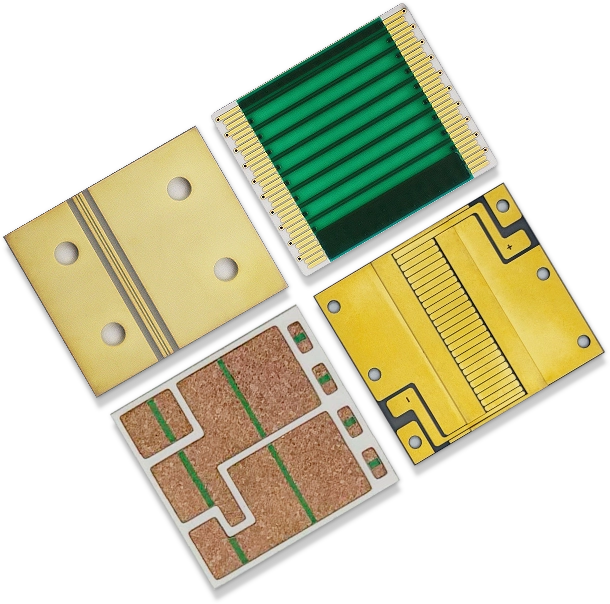 High-temperature co-firing and sintering processes are the magic moment in ceramic circuit formation. Alumina ceramics require sintering temperatures as high as 1500°C-1600°C, while aluminum nitride needs to be processed in a reducing atmosphere at 1800°C-1900°C. Temperature deviations must be controlled within ±5°C to prevent abnormal grain growth that could lead to a decrease in thermal conductivity exceeding 20%. A study on automotive electronic modules showed that optimized co-firing profiles can improve the interlayer bonding strength of multilayer ceramic substrates by 30% and reduce the resistance of internal conductors by 8%. Manufacturers such as Maruwa of Japan, with their proprietary sintering atmosphere control technology, have stabilized the flexural strength of 96% alumina substrates above 300 MPa, providing a solid foundation for applications in high-vibration environments.
Precision machining and surface treatment are crucial for meeting stringent dimensional and assembly requirements. Alumina & AlN Ceramic PCBs are typically cut using diamond wheels or lasers, achieving cutting accuracy of ±0.05 mm and a surface roughness Ra of less than 0.4 micrometers. In electric vehicle IGBT modules, aluminum nitride substrates require milling grooves 0.3 mm deep with a precision tolerance within ±0.02 mm to ensure uniform thermal paste coverage and reduce thermal resistance by 25%. Finally, surface treatments such as electroless nickel-gold plating provide a 3-5 micrometer thick solderable layer, ensuring a chip mounting void ratio of less than 10%, which is crucial for improving the long-term reliability of high-power LEDs or RF modules.
Therefore, from materials science to microfabrication, the precision of every manufacturing capability meshes like gears, jointly driving the peak performance of the final product. Manufacturers investing in these core processes can increase their product yield from the industry average of 85% to over 95%, gaining an advantage in the multi-billion dollar power electronics and RF market. When selecting suppliers, thoroughly examining their end-to-end process control data and proven case studies is the only way to ensure your project achieves optimal returns in performance, cost, and reliability.
High-temperature co-firing and sintering processes are the magic moment in ceramic circuit formation. Alumina ceramics require sintering temperatures as high as 1500°C-1600°C, while aluminum nitride needs to be processed in a reducing atmosphere at 1800°C-1900°C. Temperature deviations must be controlled within ±5°C to prevent abnormal grain growth that could lead to a decrease in thermal conductivity exceeding 20%. A study on automotive electronic modules showed that optimized co-firing profiles can improve the interlayer bonding strength of multilayer ceramic substrates by 30% and reduce the resistance of internal conductors by 8%. Manufacturers such as Maruwa of Japan, with their proprietary sintering atmosphere control technology, have stabilized the flexural strength of 96% alumina substrates above 300 MPa, providing a solid foundation for applications in high-vibration environments.
Precision machining and surface treatment are crucial for meeting stringent dimensional and assembly requirements. Alumina & AlN Ceramic PCBs are typically cut using diamond wheels or lasers, achieving cutting accuracy of ±0.05 mm and a surface roughness Ra of less than 0.4 micrometers. In electric vehicle IGBT modules, aluminum nitride substrates require milling grooves 0.3 mm deep with a precision tolerance within ±0.02 mm to ensure uniform thermal paste coverage and reduce thermal resistance by 25%. Finally, surface treatments such as electroless nickel-gold plating provide a 3-5 micrometer thick solderable layer, ensuring a chip mounting void ratio of less than 10%, which is crucial for improving the long-term reliability of high-power LEDs or RF modules.
Therefore, from materials science to microfabrication, the precision of every manufacturing capability meshes like gears, jointly driving the peak performance of the final product. Manufacturers investing in these core processes can increase their product yield from the industry average of 85% to over 95%, gaining an advantage in the multi-billion dollar power electronics and RF market. When selecting suppliers, thoroughly examining their end-to-end process control data and proven case studies is the only way to ensure your project achieves optimal returns in performance, cost, and reliability.
High-temperature co-firing and sintering processes are the magic moment in ceramic circuit formation. Alumina ceramics require sintering temperatures as high as 1500°C-1600°C, while aluminum nitride needs to be processed in a reducing atmosphere at 1800°C-1900°C. Temperature deviations must be controlled within ±5°C to prevent abnormal grain growth that could lead to a decrease in thermal conductivity exceeding 20%. A study on automotive electronic modules showed that optimized co-firing profiles can improve the interlayer bonding strength of multilayer ceramic substrates by 30% and reduce the resistance of internal conductors by 8%. Manufacturers such as Maruwa of Japan, with their proprietary sintering atmosphere control technology, have stabilized the flexural strength of 96% alumina substrates above 300 MPa, providing a solid foundation for applications in high-vibration environments.
Precision machining and surface treatment are crucial for meeting stringent dimensional and assembly requirements. Alumina & AlN Ceramic PCBs are typically cut using diamond wheels or lasers, achieving cutting accuracy of ±0.05 mm and a surface roughness Ra of less than 0.4 micrometers. In electric vehicle IGBT modules, aluminum nitride substrates require milling grooves 0.3 mm deep with a precision tolerance within ±0.02 mm to ensure uniform thermal paste coverage and reduce thermal resistance by 25%. Finally, surface treatments such as electroless nickel-gold plating provide a 3-5 micrometer thick solderable layer, ensuring a chip mounting void ratio of less than 10%, which is crucial for improving the long-term reliability of high-power LEDs or RF modules.
Therefore, from materials science to microfabrication, the precision of every manufacturing capability meshes like gears, jointly driving the peak performance of the final product. Manufacturers investing in these core processes can increase their product yield from the industry average of 85% to over 95%, gaining an advantage in the multi-billion dollar power electronics and RF market. When selecting suppliers, thoroughly examining their end-to-end process control data and proven case studies is the only way to ensure your project achieves optimal returns in performance, cost, and reliability.