White Shaker With Wood and Stone
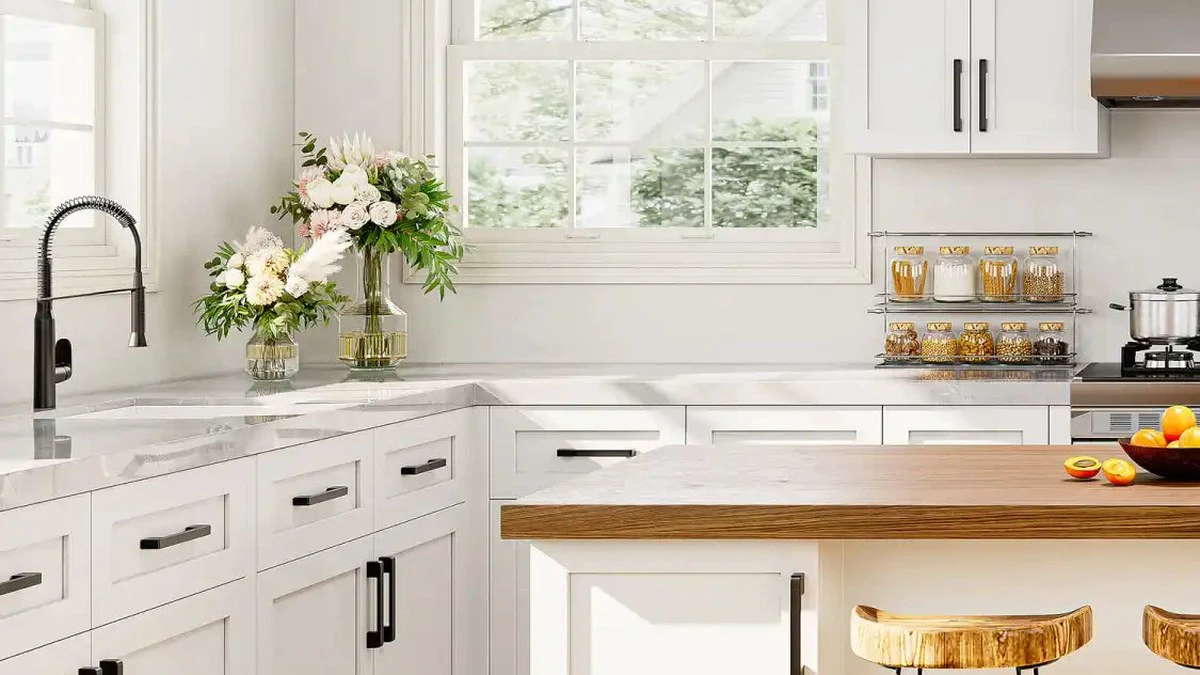
A white door is a background, and a background only looks deliberate when something is in front of it. The pairing that holds up is one warm material, one cool material and one dark accent: wood for temperature, stone for movement, metal or a painted accent for contrast. Get the undertones right and a plain white door looks expensive; get them wrong and it looks like a rental.
Key takeaways
- Pair white with one warm material and one cool material; a single partner leaves the room looking unfinished.
- Undertone decides more than color: a warm oak floor pulls a cool white toward gray, and a cool stone pulls it toward cream.
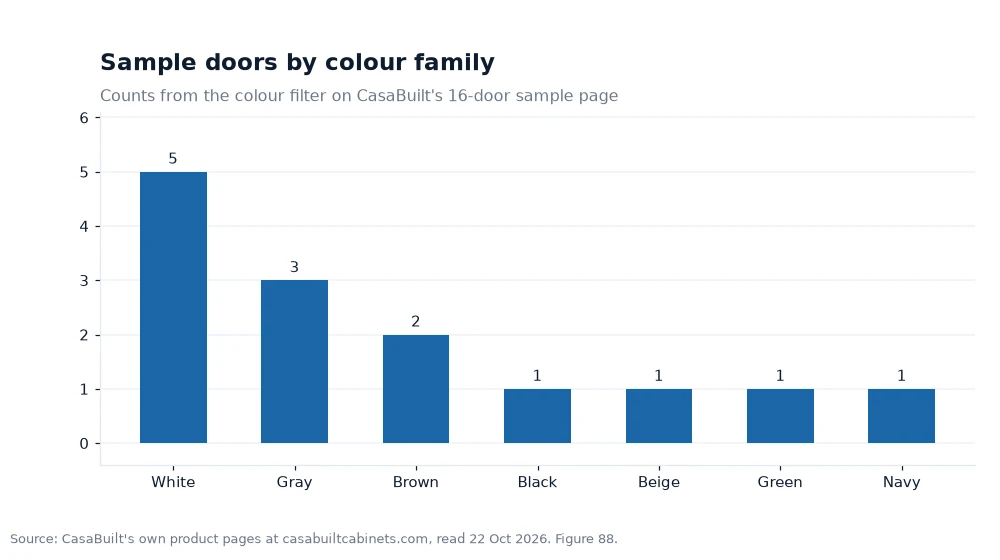
- The sample range counts 5 white, 3 gray, 2 brown and 1 each of black, beige, green and navy.
- Texture does the work that color cannot: matte paint, open wood grain and polished stone read differently under the same light.
Why white needs more than one partner
White cabinetry is the quietest surface in most kitchens, which means the eye goes looking for something else. If the only other material is a white counter on a white wall over a pale floor, the room has nowhere to land and reads as flat. Add one warm wood and one veined stone and the white suddenly has a job: it separates them.
The three-way split also survives redecorating. Wood and stone are the expensive, slow decisions; the accent is the cheap, fast one. If the hardware is the only thing that changes in ten years, the kitchen still works, because the white never belonged to a trend in the first place.
Texture is the part buyers underestimate. Matte paint, open wood grain and a polished or honed stone all reflect light differently, and that difference is what stops a two-color kitchen from looking like a flat drawing. A white door beside a honed stone and a matte oak floor has three separate surfaces; a white door beside a glossy white quartz and a white wall has one.
Wood: choose one temperature and repeat it
Wood is the warm partner, and the mistake is mixing temperatures. A red-toned oak floor with a yellow-toned pine island and a gray-toned walnut shelf gives the eye three different warms, and the white door starts to look like the only thing holding the room together. Pick one family and repeat it: floor, island, open shelf, window trim.
Grain scale matters as much as species. A wide-plank floor with a strong cathedral pattern is already busy, so the wood above it should be quieter, and the stone should be quieter still. A tight, straight grain on the island lets a boldly veined counter take the lead. Two strong patterns in one sightline fight, and the loser is usually the cabinet door, because it has no pattern at all.
The sample range carries two brown doors, which is a small number for a decision this large. That is an argument for ordering both and holding them against the actual floor rather than against a photograph of a floor. Wood changes more under a room's lighting than any paint chip does.
Stone: match the vein, not the sample chip
Stone is the cool partner, and the chip in a showroom is the worst guide to it. A small square shows color; a full slab shows movement, scale and direction. The relevant question is not whether the stone is white, gray or beige but whether its vein is soft or graphic, and whether that pattern repeats at the scale of the room.
A soft, cloudy stone lets the door stay plain and puts the interest in the counter. A graphic, high-contrast stone demands a quieter door and a quieter floor, which is exactly what the white shaker cabinets provide: no grain, no glaze, no applied detail to compete with the slab. That is the practical argument for a plain door, not a stylistic one.
Watch the undertone where the stone meets the door. A cool gray stone beside a warm cream white makes the white look yellow, and a warm beige stone beside a cool white makes the door look blue. Neither effect is visible on separate samples; both are obvious in a photograph of the finished room, which is why the samples have to be held together in the same light.
The backsplash is the third stone decision and the one most often skipped. Running the counter stone up the wall increases the pattern's share of the room; a plain tile instead gives the door a rest. If the slab is graphic, take the rest.
Accents: metal, paint and the sample drawer
The accent is where a white kitchen gets its date stamp, and it should be the last decision, not the first. Black hardware on a white door reads modern; brass reads warmer and slightly older; a painted island in navy or green moves the accent from a handle to a surface. All three approaches work, but only one at a time.
The published sample range is a useful map of how much choice exists at the accent end. It counts 5 white, 3 gray, 2 brown and one each of black, beige, green and navy across 14 color-tagged doors, which means the range is weighted toward neutrals and the saturated colors are single options. That suits a kitchen where the door is white and the accent is a small surface.
| Color family | Doors in range | Share of 14 | Usual pairing role |
|---|---|---|---|
| White | 5 | 35.7% | Cabinet field |
| Gray | 3 | 21.4% | Stone and island |
| Brown | 2 | 14.3% | Wood floor and shelving |
| Black | 1 | 7.1% | Hardware and frames |
| Beige | 1 | 7.1% | Plaster and limestone |
| Green | 1 | 7.1% | Tile and painted island |
| Navy | 1 | 7.1% | Painted island or hutch |
Order the accents as door samples even when you have no intention of buying them as cabinets. A black or green door is the cheapest way to test how a saturated surface behaves in your light before you commit a wall or an island to it.
Worked example: reading the palette as numbers
The chart values are White 5, Gray 3, Brown 2, Black 1, Beige 1, Green 1 and Navy 1. Add them: 5 plus 3 is 8, plus 2 is 10, plus 1 is 11, plus 1 is 12, plus 1 is 13, plus 1 is 14. So the color filter describes 14 doors, two short of the 16 the sample page lists in stock, and the two premium doors are priced separately at $19.50 and $22.00.
Now group them the way a kitchen is actually built. White plus Gray is 8 doors, and 8 divided by 14 is 57.1%, so more than half the range sits in the two families that carry the cabinet field and the stone. White plus Gray plus Beige is 9, or 64.3%, which is the neutral share. Black plus Green plus Navy is 3, or 21.4%, which is the accent share. Brown alone is 2, or 14.3%.
The shares should add to 100%: 64.3 plus 21.4 plus 14.3 equals 100.0. At $9.99 a door, ordering the whole tagged range costs 14 times $9.99, or $139.86, and ordering just the neutral group costs 9 times $9.99, or $89.91. The three-door accent set costs 3 times $9.99, or $29.97. The palette is the cheapest part of the design and the part most often decided from a photograph.
Frequently asked questions
What wood tone works best with white cabinets?
Any tone can work if it is the only wood in the sightline. The practical rule is to choose a floor first, then repeat its temperature on the island or the open shelving rather than introducing a second warm. Two brown doors in the sample range are enough to compare against the floor before committing.
Can a veined stone sit next to a plain white door?
Yes, and it is the easier pairing, because the plain door gives the stone room to be the feature. Keep the backsplash quiet if the slab is graphic, and check the stone and the door sample together in the room's own light rather than under showroom lighting.
Should the hardware match the stone or the wood?
Neither has to match. Black hardware reads as a deliberate accent against white and warm wood, while brass sits closer to the wood and softens the contrast. Pick one metal and repeat it at the faucet and the cabinet pulls so the room has a single accent rather than three.
Build the palette before the order
Choose the floor first, the stone second and the door third. Then order the small set that answers the question: one white, one brown and one accent, held against the actual slab and the actual floor at the same time of day. That trio costs $29.97 at the published sample price and settles more arguments than a folder of photographs.
If the trio works together, the kitchen will work, because the rest of the decisions are repeats of those three materials. If it does not, you have found the problem while it is still a $30 problem rather than a second order.
Figures quoted here come from the manufacturer's own website, read 22 Oct 2026[1].